








Before “The Mountain”
The band debuted in 2001 with their self-titled album, categorized under what they called “Zombie-Hip-Hop”. Their second and third albums, “Demon Days” and Plastic Beach, became their most popular with breakout singles such as “Feel Good Inc.,” “Dirty Harry,” “DARE,” “Stylo” and “On Melancholy Hill,” which have gone on to become some of their most popular songs. The band released their fourth album, “The Fall,” which was made entirely on an iPad, in 2011. The band then didn’t release any music after 2012 until they returned in 2017, with their most political album yet, “Humanz,” which criticized the American oligarchy and racial politics. “The Now Now,” their sixth album, released a year later, the emotional reflection of lead singer 2D split under 11 of their most beautiful songs. “Song Machine” was rolled out during COVID, with songs dropping monthly as “episodes” with their own music videos for and a new collaboration on each song. Their last album before “The Mountain” came out in 2023, “Cracker Island,” which received very mixed reviews from fans after being a departure from the band’s usual unique flair.
The Making of “The Mountain”
The inspiration for “The Mountain” came after the release of Cracker Island in 2023, when the man behind the band’s music, Damon Albarn, as well as its visual artist, Jamie Hewlett, both lost their fathers. Following their passing, the duo took a trip to Amber Fort in Jaipur, the capital of Rajasthan, which is a state in India. This trip is responsible for the album’s primarily South and South Asian influences and due to the grief the two experienced, the album is also themed around death, grief and the afterlife. This is especially present in the fifth single and fourth track on the album, The Hardest Thing, where Albarn (as singer 2D) states, “You know the hardest thing/Is to say goodbye to someone you love/That is the hardest thing.”
The Singles
After being premiered at the Mystery Show at their House of Kong Exhibit on Sept. 5, 2025, the album was commercially announced six days later, along with the release of the first single, “The Happy Dictator,” featuring the American pop duo, Sparks. The song is about media controlled by dictators and how bad news is often filtered out to push a narrative to the public. In a BBC Radio 1 interview with Albarn, he states, “the tune finds its origins in a trip [he] took a few years ago with [his] daughter to Turkmenistan,” where their former dictator, turban Bashi, wanted everyone to “sleep unaffected by the sort of doom of the world and just keep everything upbeat.” Because of this, Bashi heavily censored the media to convey the idea that everything was going great. This is present in the hook of the song, where 2D sings “No more bad news/So you can sleep well at night/And the palace of your mind/Will be bright.”
Six days after the release of “The Happy Dictator,” Gorillaz performed the eleventh track from the album, “Damascus,” with featured artists Syrian singer Omar Souleyman and rapper Yasiin Bey (formerly Mos Def) at the Together for Palestine concert in London. The song, named after the capital city of Syria, talks about fleeing refugees from Syria and how everyone is equally navigating the world together without guidance. The song is made up of two unused demos from their album “Plastic Beach,” “Sunday Monday” (which is the intro to the song) and “Fresh Arrivals” (the original version of “Damascus”). The song was officially released on December 12 as the fourth single.
Two other singles as well as a double were released before the album came out. The second single released for the album was “The Manifesto,” the longest track on the album coming in at nearly eight minutes. The album features Argentinian rapper Trueno as well as deceased D12 group member Proof, whose verse was likely recorded when Gorillaz and D12 released the song 911 after the 9/11 Terrorist Attacks.
In Nov., the band released its third single for the album, “The God of Lying,” featuring British Post-Punk band IDLES. In Jan., “The Hardest Thing/Orange County” was released as a double, with both songs containing the aforementioned hook that the hardest thing is to say goodbye. “The Hardest Thing” features deceased artist Tony Allen, who previously collaborated with Gorillaz on their song “How Far?” in 2020. While “The Hardest Thing” is possibly the slowest and saddest song on the album, Orange County takes “The Hardest Thing” and throws a bittersweet pop melody under it, almost as if the two songs tell of stages of grief, where the first song represents depression and the second acceptance. These two songs are the most prominent example of the album’s theme of exploring death and the afterlife.
The New Songs
The album itself released Friday, Feb. 27, to warm reception from the Gorillaz fanbase, with many calling it their best album since “Plastic Beach” in 2010.
The album opens with an instrumental track simply named “The Mountain,” similarly to “Plastic Beach’s” Orchestral Intro. The track has a primarily flute melody, a homage to the eastern music that inspired this album.
Following this track is arguably the standout piece of the album, “The Moon Cave.” This song features several collaborations, with Indian Singer-Songwriter Asha Puthil featured in the intro and second verse, English musician Jalen Ngonda featured on the bridge, a rap verse from “The Roots” frontman “Black Thought” and posthumous features from Bobby Womack in the intro and Dave Joliceur (Trugoy the Dove) of De La Soul in the adlibs of the rap verse. The song is one of the most unique on the album, as it has a distinct first half which is in 4/4 (standard time) and second half which is in 3/4 (waltz/swing time). This makes the song feel very complex and makes for a very enjoyable listen every time because there’s always something new you notice in the background of the song every time you hear it.
“The Empty Dream Machine” is the next new track, which features a slow beat with a quiet piano melody on top of it that makes for a very pretty song, especially when combined with Albarn’s layered vocals towards the end of his verses.” Black Thought” once again appears on this song with another intricate verse that is written very well and adds a nice change of pace to the song.
The ninth track on the album and fourth new song is “The Plastic Guru,” which compares fake news outlets to snake oil salesmen, with an on-the-nose refrain that almost shoves in your face what the song is about, saying “We believe what we choose/Is that not the truth?”
The following track, Delirium, speaks about harsh authoritarianism and how the public is forced to accept anything that their dictators tell them, however incoherent. This song also has a posthumous feature from Mark E. Smith, who was previously on the Gorillaz track “Glitter Freeze.”
The twelfth track, “The Shadowy Light,” features Hindi vocals from Asha Bhoslem, notably one of the oldest Gorillaz collaborators at 92-years-old. This song is about the blind trust that the public puts into corporations and how when our voice is stripped by the corporations (for AI, presumably) there will be nothing left for us.
The following song, “Casablanca,” named after the city in Morocco and the 1942 film, references the thin line between our “painted world”, representing our life and “The Mountain,” representing death. In this song, 2D frames life as a “gamble” between these two worlds. Without this gamble, life arguably has no excitement or meaning, but gambling too much with your life can cause you to lose it all.
The second to last song, “The Sweet Prince,” has a very familiar theme to those who are familiar with Shakespeare’s work, specifically Hamlet. Notably, both the plot of Hamlet and the inspiration for “The Mountain” both stemmed from the loss of a father. The song gets its title from what Horatio says to Hamlet as he’s dying, “goodnight, sweet prince.”
The final track on the album is “The Sad God,” the track getting its name from how the lyrics reflect a regretful God. 2D, as said God, sings about what they’ve given to humans and what they’ve gotten in return, such as where they say, “I gave you white sails/To reach the sun/I gave you atoms/You built a bomb.” The album also reflects how humans and their self-destruction tendencies will drive away their gods, leaving “only screens left to see your face.” Following the first verse is “Black Thought”’s third feature on the album, a fitting bookend as he was also the first vocal feature on the album. Following his verse, 2D reprises their first verse and then the rest of the song is entirely instrumental, bringing back the same melody from the opening instrumental track (“The Mountain”), representing how our time on Earth is but a cycle.
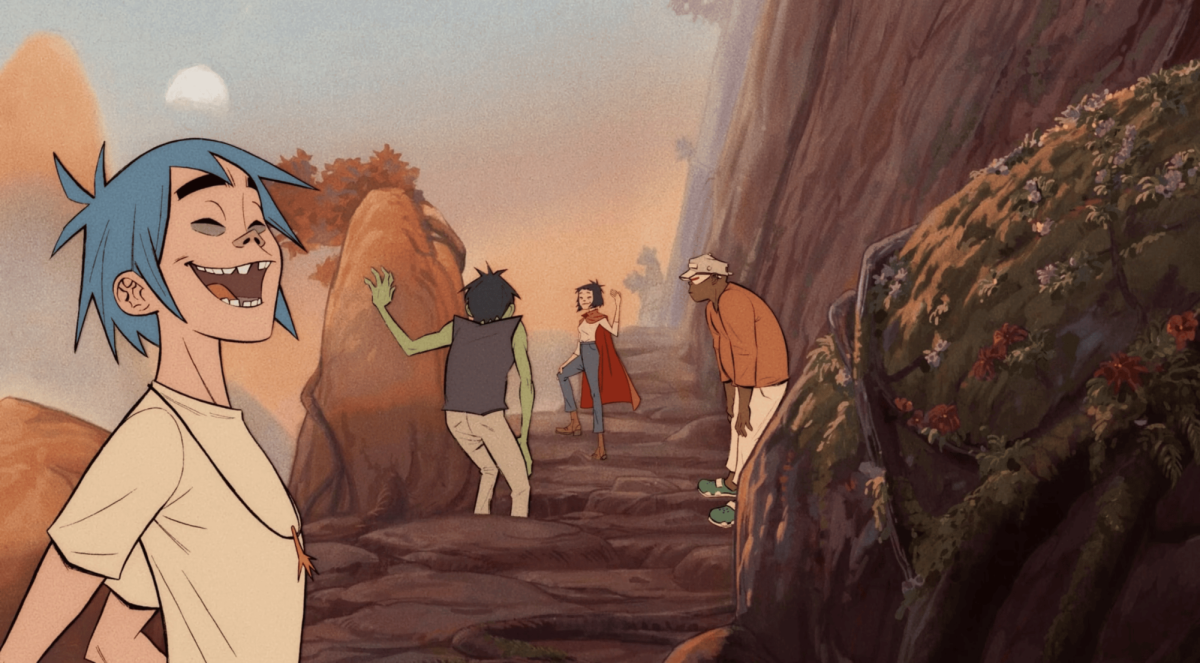
A short film featuring the songs “The Mountain,” “The Moon Cave” and “The Sad God” was released the same day as the album release on their YouTube channel, notably featuring no AI art as illustrator Jamie Hewlett seeked to separate Gorillaz from modern corporatism and with traditional, human-made art. After all, only humans know how to write about something as fragile and precious as a human life.