

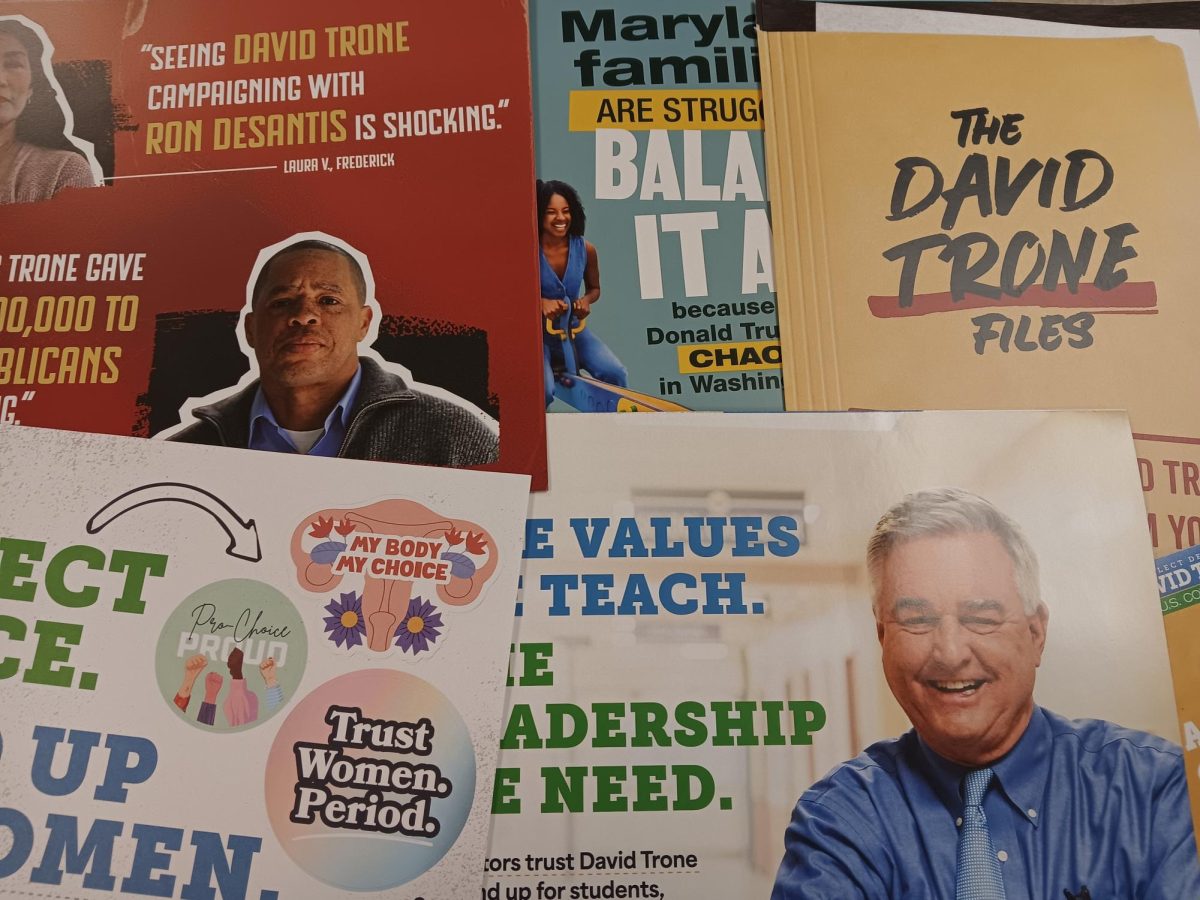














If you’ve checked your mailbox over the past few months, there is no doubt you’ve received a scathing ad from one of the congressional candidates for the 2026 Maryland state primary election on Jun. 23, 2026. Per Ballotpedia and the sample ballots, Maryland elections this year will cover the House of Representatives, the Governor, State Congress, State Supreme Court and Appellate Courts, School Boards, Municipal Governments, and two amendments. By far the most intense political battle this season has been between front runners April McClain-Delaney and David Trone, who among six other candidates are competing for the single District 6 Representative position.
McClain-Delaney is the current representative after being elected in 2024. Prior to her election, she worked with the nonprofit Common Sense Media, was appointed for the Department of Commerce under the Biden administration, and earned a Juris Doctor from Georgetown University’s Law Center, which she used to practice her career as a media lawyer. During her previous term, she worked on directing more funds toward agriculture and the environment, deregulation of small businesses and construction (for affordable housing), opposing Federal layoffs, and strengthening NATO. She has been described by The Baltimore Sun as one of of Maryland’s wealthiest congressional members. Many voters find it hard to vote for her because of her perceived bipartisanship. Fox News reporter Shannon Bream described McClain-Delaney as a “centrist Democrat” in a 2024 article, and voted with President Trump 1 in 5 times during her last term according to VoteHub. She has faced heavy criticism from opponent David Trone over her vote for the Laken Riley Act per Ballotpedia, which “allows the detention of individuals residing in the country without legal permission who are accused but not convicted of crimes.” Her husband, John Delaney, was elected as the representative in 2012 and served until his term ended after the 2018 election, where his successor was none other than April’s political rival, David Trone.
Trone served from his election in 2018 until he was replaced by McClain-Delaney in 2024. Prior to his congressional career, Trone founded the Pennsylvania alcohol retailer Beer World in 1984. Trone’s larger business began to overtake the smaller alcohol retailers in the area and several filed complains against him, which would lead to his arrest on three occasions in the late 1980’s and early 1990’s. However, the charges against Trone in all three cases were dropped. Some of Trone’s biggest issues he worked on were “anti-consumer laws passed after prohibition” (due to his family owning the large liquor retailer Total Wine & More), pushing in favor of abortion rights, electoral reform, and support for mental health. However, one issue Democrats have had with Trone is that he has given six figures to Republican politicians to support “legislation or regulatory changes beneficial to his company” (per a 2016 article by The Washington Post). However, in terms of social issues such as January 6th, Trone has not sided with the Republicans, as on several occasions he has stated his discontent for President Donald Trump on social media, something he tries to make very clear in his ad campaigns. Despite this, it is still hard for Trone to earn the support of many, as a lot of people feel that he is only in office to support his ego and his business ventures, and April McClain-Delaney has emphasized this, stating in a YouTube video in December of 2025 that “this race isn’t about one man’s ego” and she’s “willing to stand up to ‘bullies’.” In April, McClain-Delaney issued a cease-and-desist against Trone, for using the term “re-elect” in his ads despite not having held office since the end of the previous term.
Whilst these two are no doubt the favorites, there are six other candidates that at least deserve a mention.
Two candidates are returning from the previous Maryland primary: Kiambo “Bo” White and Altimont Wilks. White’s campaign is built on “safeguarding personal freedoms” (such as reproductive rights), “fair and accessible electoral processes”, and overall “holistic and forward-thinking approaches” to governing (from his campaign site). Wilks, a corner store owner, wants to focus on a “middle-of-the-road” approach to deliver “real solutions,” and boasts that he has successfully sued the USDA after his store was unable to accept SNAP benefits.
The only other candidate that has been as actively campaigning as McClain-Delaney and Trone has been George Gluck. Gluck is from Czechoslovakia and currently resides in Rockville, and has earned two masters degrees which he used for his careers as a mathematician and software engineer prior to his political campaign. He has previously been an election judge, which is his only experience with public office thus far. Gluck’s advertising has included statements about affordability and fighting back in Congress against the majority Republican leadership.
Alexis Goldstein is also for sure a prominent candidate, being on the younger side at 45 years old. Alexis worked at Wall Street before quitting to protest with Occupy Wall Street in 2010. She has worked primarily on financial issues such as prioritizing regulations and reform especially in terms of student debt. She has been an active guest speaker on many news programs such as NPR, CNBC, and Democracy Now. Prior to her firing under Elon Musk’s Department Of Government Efficiency (DOGE), she worked as a Chief Technologist under the Consumer Financial Protection Bureau (CFPB). Goldstein is a self-described progressive candidate, and has criticized House Democrats for their inefficiency at standing up to policies they claim to be against in their ad campaigns. Goldstein will likely be a hit with younger, more progressive voters who are aware of her campaign.
Ethan Wechtaluk is another progressive candidate, being a part of the Action Network, a political organization that encourages activism and peaceful protest for progressive causes. Wechtaluk promises three main things that he will bring if elected; “Affordability, Accountability, [and] Community.” Wechtaluk boasts on his campaign’s website that he is not receiving any outside financial support other than direct donations, stating “No Billionaires. No PACs. Just Us.” He directly calls out McClain-Delaney and Trone in the first paragraph of his website’s statement as not wanting voters “looking too closely at who they’re fighting for.” This is a direct reference to AIPAC and Corporate money that both have received, and more and more younger voters are unwilling to vote for a candidate that they consider “sold out.” Wechtaluk has spent 15 years working as a federal consultant, and promises that he’s “willing to confront power even when it’s uncomfortable” and continuing his career “on the side that fixes problems and delivers.”
Although there are eight candidates that each have their own reasons they might garner voters, in the end it most likely will come down to McClain-Delaney or Trone. These two both have experience as the representative, their campaigns have been the most widespread, and their more moderate approaches compared to some of the other candidates will likely have the largest appeal to the middle-aged and older populations, who will likely care more about the midterms than the younger generations (according to a 2025 article by AARP). If you’re of voting age, it is especially important to vote in the primaries to get who you want to the general election. After all, it isn’t just the President who matters when you vote, but everyone you give power to.